Quick answer
58mm is the groupfilter diameter used across almost every commercial café machine, and dropping under $300 for it used to mean settling for something bare-bones in every other respect. Four machines now cover this bracket without that usual trade-off. The Gevi Dual Boiler Espresso Machine With Grinder & 58mm Portafilter at $270.44 is the one to start with: it bundles a built-in grinder, the 58mm head and a separate steam boiler in one unit, the only machine here that does all three. For less money, the AMZCHEF Espresso Machine with Grinder at $199.48 undercuts it by roughly $60 and still ships a grinder — one with 40 named grind settings, a number none of the other three publish. The HIBREW H10 at $169.99 skips the grinder but adds a one-touch pressure release you can customize, a feature neither of the others names at all. The Tuni E2 Gen3 at $241.44 sits at the top of the range with its own dual boiler and what Tuni calls Super+ Steam Power, in Ivory — the second dual boiler in this guide, and the only one of the four without a stated grinder.
Why there are no star ratings on this page
Amazon's product data returns no rating and no review count for any of the four machines named in this guide, so we don't print one and we don't paraphrase review sentiment we can't verify. Every claim below traces back to a published spec, a recorded price, or a general, well-documented fact about how espresso brews.
Things to know before you buy
- A 58mm portafilter is the size used across most commercial café equipment — the E61-style standard — which is exactly why the aftermarket for it (baskets, bottomless portafilters, tampers) runs deeper than for proprietary sizes like 54mm or 51mm.
- Only one of the four listings here publishes an exact footprint: Gevi's, at 16.61 x 15.66 x 18.85 inches. For the other three, check the live listing photos before assuming a counter fit.
- Two of the four — Gevi and Tuni — have a dual boiler, letting the brew and steam sides reach independent temperatures. That's a feature usually reserved for machines well north of $300, so finding it twice in this range is the headline of this guide.
- Grind settings are explicitly stated for exactly one machine here: AMZCHEF's 40. The other three either skip the grinder entirely or don't publish a settings count.
- Espresso brews at roughly 9 bar at the coffee puck — background worth keeping in mind when judging any pressure-related claim on these listings, HIBREW's included.
Why you should trust this guide
We do not physically test these machines and we do not run a testing lab. What follows compares what each manufacturer states on its own listing — portafilter size, boiler count, grinder specification and price — against general, well-documented facts about how espresso brews and why 58mm became the size most aftermarket gear is built around. Ilane Tall has covered this category on this site since launch, and every guide here is built the same way: from published specifications and the price we most recently recorded, not a session with the machine in front of us. Where a listing simply doesn't state a spec — wattage on three of these four, tank size on all four — we say so rather than estimate one. Our guide to built-in scales runs into the identical gap from the dosing side, if published-spec gaps are something you want to see more of before buying.
Why 58mm matters
Portafilter diameter is one of the least glamorous specs on an espresso machine and one of the most consequential once you own it. The number refers to the basket and portafilter that lock into the group head — the part loaded with ground coffee before a shot — and 58mm is the size nearly every commercial café machine uses, a holdover from the La Marzocco and E61-style designs that still define professional equipment. Decades of cafés standardizing on that one size is why the aftermarket around it runs so much deeper than anything built around a proprietary diameter.
Concretely, that means three things are easy to buy for a 58mm machine and genuinely hard to find for most other sizes: precision baskets from third-party makers that distribute water more evenly than many stock baskets, bottomless — or "naked" — portafilters that let you watch the extraction stream and catch channeling before it ruins the cup, and tampers that fit without the half-millimeter wobble that comes from hunting down an off-brand size. Breville's 54mm and the 51mm baskets common on many budget semi-automatics work perfectly well out of the box, but step outside what shipped in the box and the accessory shelf narrows fast — fewer third-party basket options, fewer bottomless portafilters sized to fit, sometimes none at all depending on the exact variant.
That's the real argument for paying attention to this number rather than treating it as a spec-sheet footnote. A $300 ceiling on a 58mm machine buys the same starting point a commercial kitchen works from, and a clear upgrade path if you ever want a different basket than the one in the box. HIBREW and Gevi both state 58mm directly in their listing names; AMZCHEF and Tuni are grouped into this same bracket on the same basis, though their listing titles lead with the grinder and boiler features rather than the basket number — worth a quick check against the current Amazon listing if portafilter diameter is the one spec you're buying for.
What usually gets cut to hit 58mm under $300
58mm group heads are physically larger than 51mm or 54mm ones — more metal, a wider boiler interface, a heavier portafilter — and all of that costs more to manufacture than a smaller equivalent. Machines in this bracket pay for the larger format by trimming something else, and the pattern across these four listings is consistent: it's the spec sheet itself that shrinks first.
Wattage is stated for exactly one of the four machines here, AMZCHEF's 1500W. Tank size is stated for none of them. Footprint is stated for exactly one, Gevi's 16.61 x 15.66 x 18.85 inches. That's not four unrelated manufacturers happening to leave the same fields blank by coincidence — a listing that doesn't publish a number is usually one where that number isn't the sales pitch, because the budget went toward the portafilter diameter and, for Gevi and Tuni, a second boiler, rather than toward the kind of precision features that would normally justify naming a wattage figure or a temperature display.
Accessory kits are the other place the savings show up. None of the four listings mention a dose-trimming tool, a bottomless portafilter included in the box, or more than one basket size — all standard inclusions once you're well past $300 on something like a Breville Barista Express. That matches our look at Thermoblock versus boiler designs at a lower price tier: the corners get cut in what ships in the box and in what the listing bothers to state, not usually in the headline feature the product is named after.
HIBREW's customizable pressure release
The HIBREW H10 Customizable 58mm Espresso Machine, One-Touch Pressure Release is the only machine in this guide built around a single named mechanism rather than a spread of features, and the name tells you exactly what that mechanism is. A pressure release — often called an OPV, or over-pressure valve, on machines that have one — vents brew pressure out of the group head, typically once a shot finishes, so the puck isn't still sitting under pressure when you unlock the portafilter to knock it out. Without one, pulling the portafilter immediately after a shot can spit hot coffee and grounds back at you; with one, a quick purge drops the pressure first.
What HIBREW adds, per its own listing name, is that the release is customizable and one-touch rather than fixed — you control when the purge happens rather than the machine running it on a fixed timer, and it's a single action rather than a multi-step process. At $169.99, that's a genuinely specific feature to build a listing name around, and it sits at the lower end of this four-machine range: only AMZCHEF, at $199.48, costs less.
What the listing doesn't state is a grinder. If the HIBREW is on your shortlist, budget for pairing it with a separate burr grinder — the same bring-your-own-grinder route covered in our guide to visible bean hoppers, which looks at the built-in side of that same decision.
Gevi and Tuni: the two dual boilers compared
A dual boiler is the rarest feature in this entire price bracket, and this guide has two of them: the Gevi Dual Boiler Espresso Machine With Grinder & 58mm Portafilter at $270.44, and the Tuni E2 Gen3 Dual Boiler Espresso Machine with Super+ Steam Power at $241.44. Both solve the same underlying problem — a single boiler has to switch between brewing temperature and steaming temperature, so pulling a shot right before or after frothing milk usually means a wait while the machine catches up. Two independent boilers remove that wait: one stays at brew temperature, the other at steam temperature, continuously.
Where they diverge is everything built around that shared feature. Gevi pairs its dual boiler with a built-in grinder, so the $270.44 price covers grinding, dual-boiler brewing and the 58mm portafilter in one unit — the only machine in this guide that bundles all three. Its listing also states an actual footprint, 16.61 inches deep by 15.66 wide by 18.85 tall, the only one of the four to publish exact dimensions; a dual boiler plus a grinder hopper is a lot to fit on one chassis, and that's the number to check against your counter and any cabinet above it before ordering.
Tuni's E2 Gen3 skips the grinder — its listing doesn't name one — and spends its $241.44 on the dual boiler plus what the brand calls Super+ Steam Power, language that points specifically at the steaming side of the two boilers rather than the brew side. If your priority is milk — lattes, flat whites, back-to-back drinks for more than one person — a dual boiler with steam power called out by name is a more direct match than one bundled with a grinder you may already own. If your priority is one box that handles the grinding too, Gevi's $270.44 does more for less. Our comparison of automatic grinding against a dedicated dual boiler covers the same fork in the road at a much higher price tier, if you want to see how the trade-off scales.
The picks
Four machines, ordered by who each is for rather than strictly by price. Every spec below is what's published in the product listing — where a listing doesn't state something, we've left it out rather than guessed.
01Best overall
Gevi Dual Boiler Espresso Machine With Grinder & 58mm Portafilter
The only machine here that bundles a grinder, a dual boiler and the 58mm head in one box
Dual boiler · built-in grinder · 58mm portafilter · 16.61"D x 15.66"W x 18.85"H
At $270.44, Gevi covers more of this guide's checklist than any other single machine: a 58mm portafilter for the deeper aftermarket basket and tamper selection, a built-in grinder so you're not budgeting for a second appliance, and a dual boiler so milk and espresso aren't fighting over the same heating element. It's also the only one of the four with a stated footprint, which matters more than usual given how much hardware is packed into that chassis.
The trade-offThe listing doesn't state a grind-settings count or wattage, so if dialing in matters more to you than convenience, weigh it against AMZCHEF's stated 40 settings before deciding.
02Best value
AMZCHEF Espresso Machine with Grinder
The cheapest way into this bracket, with the only stated grind-settings count
Built-in grinder, 40 settings · 1500W · 58mm portafilter
AMZCHEF undercuts every other machine in this guide and still ships a grinder — one whose listing states exactly 40 grind settings, a number none of the other three publish. 1500W is also the only wattage stated across all four machines here, which at minimum tells you AMZCHEF's manufacturer is willing to put more numbers on the page than its competitors.
The trade-offNo boiler type, tank size or footprint stated, and no dual boiler — if a two-boiler setup or a confirmed footprint matters more to you than the lowest price, Gevi or Tuni are the better fit.
03Best single feature at the low end
HIBREW H10 Customizable 58mm Espresso Machine, One-Touch Pressure Release
A specific mechanism, named and built around, rather than a feature list
58mm portafilter · customizable one-touch pressure release
HIBREW's entire listing name is built around one thing: a pressure release you control with one touch rather than a fixed, automatic purge. At $169.99 — the second-lowest price in this guide — that's a legitimately specific, checkable feature rather than a vague convenience claim, and the 58mm portafilter means the basket and tamper upgrade path is the same one the pricier machines here get.
The trade-offNo grinder stated, so plan to pair it with a separate burr grinder from the start — see our bean-hopper guide for what the built-in alternative looks like at a similar price.
04Best for milk
Tuni E2 Gen3 Dual Boiler Espresso Machine with Super+ Steam Power, Ivory
The second dual boiler in this guide, pointed specifically at steaming
Dual boiler · Super+ Steam Power · Ivory · 58mm portafilter
At $241.44, Tuni sits right at this guide's ceiling and spends the money on two boilers plus steam output called out specifically by name — not a grinder, which its listing doesn't mention. If lattes and flat whites, especially more than one in a row, are the actual reason you want a dual boiler, Tuni's naming points more directly at that use case than Gevi's grinder-plus-dual-boiler bundle.
The trade-offThe most expensive machine in this guide and the only dual boiler without a stated grinder — budget for one separately, and note that no wattage, tank size or footprint is published for it either.
How the four compare
Same four machines, side by side. Prices are what we most recently recorded for each — confirm the live price before buying.
| Machine | Boiler | Grinder | Price | |
|---|
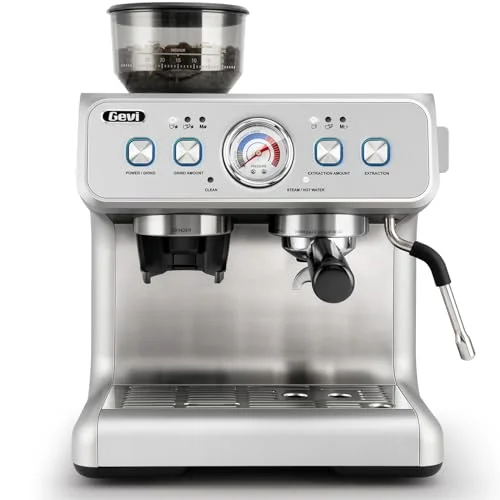 Gevi Dual Boiler with Grinder | Dual | Built-in, 58mm | $270.44 | Price |
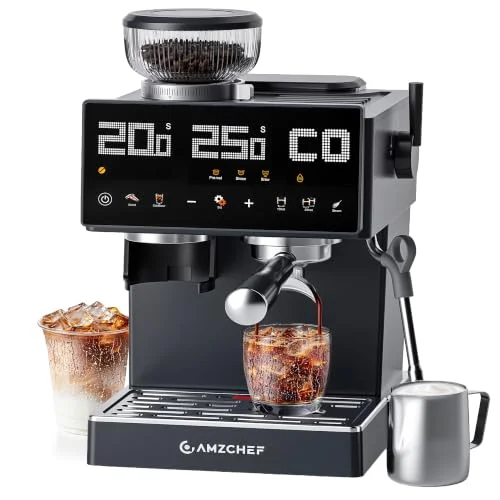 AMZCHEF with Grinder | Not stated | Built-in, 40 settings | $199.48 | Price |
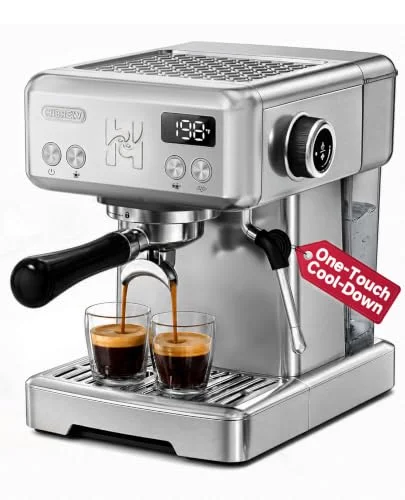 HIBREW H10 | Not stated | Not stated | $169.99 | Price |
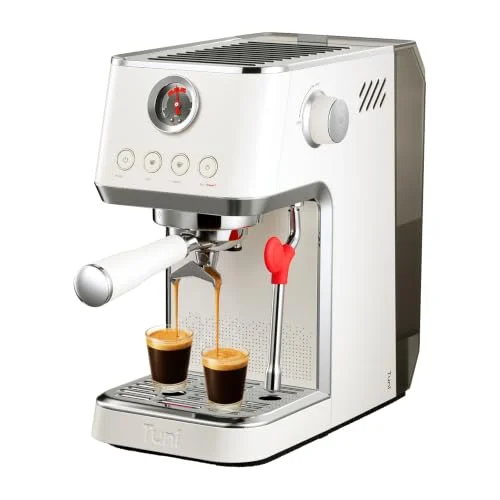 Tuni E2 Gen3 | Dual | Not stated | $241.44 | Price |
AMZCHEF's 40 grind settings against the other three
Grind-settings count is one of the most useful numbers for judging how finely a machine lets you dial in, because the gap between a sour, under-extracted shot and a bitter, over-extracted one is often a click or two wide on a home grinder — more settings mean more chances to land in that window rather than straddle it. Of the four machines in this guide, exactly one states a number: AMZCHEF's 40.
The other three don't publish a settings count at all, for different reasons. HIBREW and Tuni don't name a grinder in their listings, so there's nothing to count — if you pair either with a separate burr grinder, the settings question moves to whichever standalone grinder you choose instead. Gevi does include a built-in grinder, which makes its silence on settings count the more notable gap: it's the one direct comparison point where AMZCHEF's listing simply says more. That doesn't mean Gevi's grinder is worse — grind range and step size vary independently of how many settings a dial has, and a coarser total range split into 40 steps can still be less useful than a wider range split into fewer — it means AMZCHEF is the only one of the four willing to put a number on the page.
For a buyer choosing between AMZCHEF and Gevi specifically, that asymmetry is worth weighing against the rest of each spec sheet: AMZCHEF is roughly $60 cheaper and names its grind-settings count; Gevi costs more but adds a second boiler and a stated footprint. Whether 40 named settings beats an unstated count paired with a dual boiler depends on which of those two features you'd actually use on a weekday morning.
When a 51mm or 54mm basket is still the smarter buy
None of this is an argument that 58mm is always the right basket size to buy. It's the size with the deepest aftermarket, which matters a great deal if you plan to swap baskets, add a bottomless portafilter, or upgrade accessories over the years — and matters much less if you're buying one machine, running the basket it ships with, and never touching the aftermarket at all.
54mm, mostly Breville's proprietary size, and 51mm, common across a wide swath of budget semi-automatics, both have real advantages that have nothing to do with aftermarket depth. Smaller baskets generally mean a smaller group head, which generally means a smaller, lighter overall machine — relevant if counter space is the actual constraint rather than basket diameter. They're also frequently cheaper to manufacture, which is a real part of why machines well under $200 can exist at all; our guide to grinder-equipped machines under $150 covers three of them, none at 58mm, all considerably cheaper than anything in this guide.
The smaller size is also the smarter buy if you're not yet confident espresso will stick as a habit. Spending less now and finding out whether you'll actually use a machine every morning is a better bet than paying a premium for an aftermarket ecosystem you may never touch. The 58mm upgrade path is still there later — a first machine isn't a permanent decision, and the standalone grinder or bottomless portafilter you'd buy for a 58mm machine works just as well on your second one as it did on your first.
How we compared
We compare what's published on each manufacturer's own listing — portafilter size, boiler count, grinder specification, grind-settings count and price — against general, well-documented facts about how espresso brews and why certain specs matter more than others. We read marketing language carefully rather than skeptically dismissing it: HIBREW's "customizable" pressure release and Tuni's "Super+ Steam Power" are specific enough claims to take at face value, while a generic "premium" or "professional-grade" claim would get no weight at all. We do not physically test these machines, we do not run a testing lab, and we do not publish ratings we cannot verify — Amazon's product data returns no rating and no review count for any of the four machines named here, so there are no stars and nothing paraphrased from reviews anywhere on this page. Where a claim is a judgment rather than a specification — that Gevi is the strongest overall pick, that a 51mm or 54mm machine is the smarter buy for a first-time buyer — we've said so in our own voice, the same method we use across every guide on this site, including our main espresso machine guide. Specs that would normally appear in a comparison like this one — wattage on three of the four, tank size on all four, footprint on three of the four — simply aren't published on these listings, and we've said so rather than filled the gap with a guess.
Frequently Asked Questions
What does a 58mm portafilter actually get me that a 51mm or 54mm one doesn't?
Mainly a deeper aftermarket. 58mm is the diameter most commercial café machines use, so third-party precision baskets, bottomless portafilters and tampers are made for it far more often than for proprietary sizes like Breville's 54mm or the 51mm common on budget semi-automatics. The machine itself doesn't necessarily brew better espresso at 58mm — it gives you more room to upgrade later without hunting for a size that barely exists in the aftermarket.
Is HIBREW's one-touch pressure release the same thing as PID or pre-infusion?
No. A pressure release, or OPV, vents brew pressure out of the group head, typically after a shot finishes, so the puck isn't still under pressure when you unlock the portafilter. PID is temperature control and pre-infusion is a gentle start to the brew cycle — different mechanisms entirely. HIBREW's listing names the pressure release specifically and doesn't claim PID or pre-infusion, so we haven't attributed either to it.
What's the real difference between Gevi's dual boiler and Tuni's?
Both give the brew and steam sides independent temperatures instead of one shared boiler, which is the core benefit of the feature either way. Gevi pairs it with a built-in grinder and a stated footprint, for $270.44. Tuni skips the grinder, names its steam output specifically as Super+ Steam Power, and costs $241.44 — the higher price buys more steam-focused branding and two boilers, not a grinder.
Should I buy the cheapest 58mm machine here, or spend more?
That depends on which feature you'd actually use. AMZCHEF, at $199.48, is the cheapest and the only one with a stated grind-settings count. If a dual boiler or a confirmed footprint matters more to your routine than saving roughly $60, Gevi or Tuni are built around those features specifically rather than around price.
Keep reading