The short answer
These are the same machine with one part swapped. The Ninja Luxe Café Mini (ES301) at $449.99 and the Ninja Luxe Café Mini Plus with AutoFroth (ES351) at $499.99 share the same compact, one-or-two-cup footprint, the same built-in burr grinder, and the same precision scale for dosing beans and water. Both run Ninja's Barista Assist technology, which handles the grind-and-dose steps automatically before you ever reach for milk.
Where they split is the steam side. The Mini has a manual steam wand: you hold the pitcher, you work the angle, you make the microfoam. The Mini Plus replaces that with AutoFroth, a hands-free system that textures and dispenses milk on its own. That is the entire difference between a $449.99 machine and a $499.99 one — not the brewing, not the grinding, not the size. Just how the milk gets steamed.
If you already know how to texture milk, or you only drink straight espresso, the manual wand on the Mini does the same job for $100 less. If hands-free convenience at the milk step is the whole reason you're looking at a one-or-two-cup machine in the first place, the Mini Plus is the one built for that.
What's identical: footprint, grinder, scale
Both machines come from the same shrink of Ninja's Luxe Café line: a one-or-two-cup espresso and drip machine built for a counter that can't fit a full-size bean-to-cup unit. Ninja's listing for each model describes the same core hardware — a built-in burr grinder and a precision scale — so the brewing side of the machine is not where the $100 goes.
The burr grinder matters for the same reason it matters on any espresso machine: grind size is the primary control over how a shot extracts, and a burr grinder produces the uniform particle size that a blade grinder cannot. Having it built in means no separate appliance, no separate plug, no separate thing to clean — one footprint, one grinder, grind straight into the basket.
The precision scale is the less common feature of the two, and the more interesting one. Instead of eyeballing a dose by volume — a scoop, a level line on a basket — the machine weighs the beans and the water against the ratio it's targeting. Espresso punishes dose inconsistency: a gram or two of coffee either way changes the ratio you're pulling against and makes the shot taste different for reasons that have nothing to do with your grind setting. Building the scale into the machine removes that variable before you've touched a single dial.
Because both models share this hardware, neither one is the "serious" machine and the other the "convenience" machine in the usual bean-to-cup sense. They are the identical machine twice, with a $100 fork in the road at the steam wand.
Ninja Luxe Café Mini (ES301)
Built-in burr grinder, precision scale, manual steam wand, one-or-two-cup footprint. Espresso and drip coffee in one compact chassis.
$449.99 Check price →
What Barista Assist automates before frothing even starts
Both machines run Ninja's Barista Assist technology, and it's worth separating what that actually does from what the steam wand does, because the two get conflated in casual reading of the product names.
Barista Assist is the layer that sits between "beans in the hopper" and "espresso in the cup." It governs the grind-and-dose sequence that the built-in burr grinder and precision scale execute together — weighing the dose, grinding to the machine's set parameters, and managing that side of the process so you're not separately operating a grinder, a scale, and a tamper as three different decisions. That's the automation both machines give you identically, every time, regardless of which steam system sits below it.
What Barista Assist does not do, on either machine, is make the milk. Frothing is a separate subsystem — manual wand on the Mini, AutoFroth on the Mini Plus — and it's the one piece of the workflow where the two models genuinely diverge. Everything upstream of that, the part that decides whether your shot itself is well-pulled, is the same automated sequence on both machines. The $100 gap starts exactly where the espresso ends and the milk begins.
Manual wand vs. AutoFroth: the one feature the $100 buys
This is the entire comparison, so it's worth being precise about what each side actually is.
The Mini's manual steam wand is the traditional espresso-machine tool: a metal arm that injects steam into a pitcher of milk, and you control the result — how deep the wand sits, what angle you hold it at, how long you steam. Done well, a manual wand produces finer, more adjustable microfoam than most automated systems, and it's the only route to latte art, because you're shaping the pour yourself. Done poorly, or done by someone who hasn't practiced, it produces milk that's either flat or over-aerated, and the learning curve is real — it typically takes a number of attempts before the technique becomes repeatable.
The Mini Plus's AutoFroth system replaces that manual-technique step with a hands-free one. You position the milk, start the function, and the machine textures and dispenses it without you holding or angling anything. The trade is the mirror image of the wand's: you give up the fine manual control that produces latte-art-grade microfoam, and you get a milk step that doesn't require technique, doesn't require practice, and doesn't ask you to stand at the machine mid-pour.
Neither system is objectively better — they're built for different mornings. A manual wand rewards someone who wants to get good at it and cares about the result enough to practice. AutoFroth rewards someone who wants the milk handled while they do something else, and who would rather have consistent-but-automated foam every time than occasionally-excellent hand-steamed foam on the days they have the patience for it. That is the $100, in full.
The picks
01Lower cost, manual control
Ninja Luxe Café Mini (ES301)
For the person who wants to learn the steam wand, or doesn't need milk at all
$449.99 · built-in burr grinder · precision scale · manual steam wand · one-or-two-cup footprint
The Mini gets you the identical grinding and dosing hardware as the Mini Plus for $100 less, and the only thing you're trading away is hands-free milk. If you drink mostly straight espresso, or you're willing to put in the practice on a manual wand — which is also the only route to real latte art — this is the machine. It's also the better pick if you simply want to spend less and don't see automated frothing as something you'd use every day.
The trade-offMilk drinks take your attention and a bit of technique. If that sounds like a chore rather than a skill worth having, the $100 upgrade removes it entirely.
02Hands-free milk
Ninja Luxe Café Mini Plus with AutoFroth (ES351)
For the person who drinks milk-based espresso daily and wants it automated
$499.99 · built-in burr grinder · precision scale · hands-free AutoFroth · one-or-two-cup footprint
Identical espresso side to the Mini, with AutoFroth doing the milk work without a wand, a pitcher technique, or your hand holding anything mid-steam. For a household that drinks lattes or cappuccinos most mornings and wants the milk step to be as automated as the grind-and-dose step already is on both machines, the extra $100 buys exactly that consistency.
The trade-offAutomated frothing gives up the fine manual control a wand offers — no latte art, and less headroom to dial in a specific microfoam texture by hand.
Side by side
| Machine | Price | Grinder | Scale | Milk | |
|---|
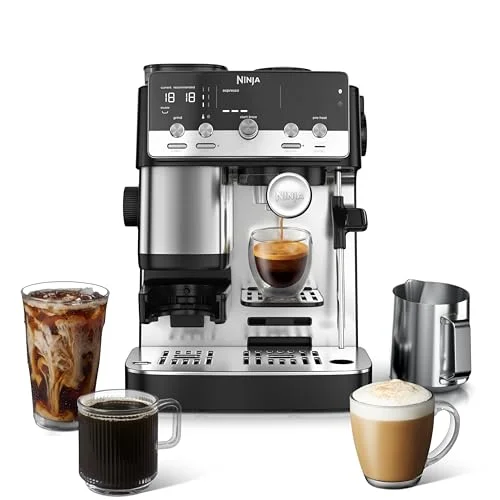 Ninja Luxe Café Mini (ES301) | $449.99 | Built-in burr | Precision scale | Manual steam wand | Price |
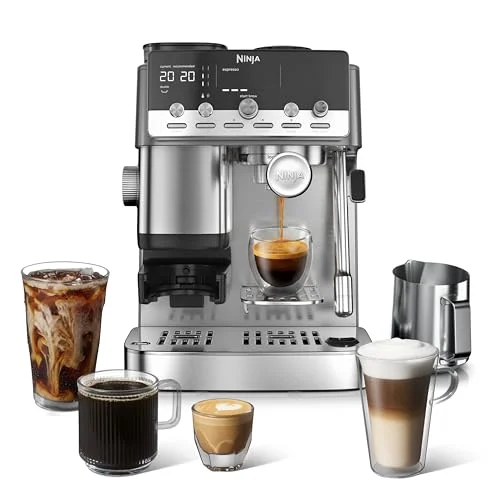 Ninja Luxe Café Mini Plus (ES351) | $499.99 | Built-in burr | Precision scale | Hands-free AutoFroth | Price |
Cleaning a manual wand vs. an AutoFroth system
Milk residue is the part of espresso-machine ownership that gets skipped and then regretted, and the two systems ask for different habits.
A manual steam wand is mechanically simple: a metal tube with a tip, typically with no internal milk pathway beyond the tip itself. The standard routine is to purge the wand with a burst of steam immediately after use and wipe the outside down before the milk dries on it — a few seconds, done at the machine, right after you steam. Skip it a few times and dried milk cakes onto the tip and the holes, which is unpleasant and, left long enough, can affect how the wand steams on the next drink.
An automated frothing system like AutoFroth routes milk through an internal pathway — tubing and a mixing chamber the milk travels through before it's dispensed — rather than through a single exposed metal tip. That internal path is exactly why hands-free frothing is possible, and it's also the part that needs a deliberate cleaning cycle rather than a quick wipe, since milk sitting unseen inside tubing is worse than milk sitting visible on a wand tip. Specifics of that cleaning cycle — whether it's a rinse function, a disassembly step, or both — are in Ninja's manual for the Mini Plus, and that manual is the authority on it, not us; we have no testing lab and haven't run either machine's cleaning cycle ourselves.
Neither system is "zero-maintenance." The manual wand asks for a short, frequent habit; the automated system asks for a less frequent but more involved one. If you're the type who forgets quick post-use habits, the automated cycle you have to run deliberately may actually suit you better — it's harder to half-do.
Who actually needs hands-free frothing on a one-or-two-cup machine
Worth asking directly, because the AutoFroth upgrade is easy to default into without checking whether it matches how you actually drink coffee.
A one-or-two-cup machine is, by definition, sized for a single person or a couple making one drink at a time rather than a household running through six cappuccinos before work. That changes the math on hands-free frothing in a specific way: the entire point of automating a repetitive task is saving time and attention across repetitions, and on this footprint the repetitions are naturally few. One person steaming milk for one latte isn't the same use case as a shared office machine running the wand a dozen times before 9 a.m.
AutoFroth earns its $100 for a few specific readers. If you drink a milk-based espresso drink daily and have never learned — or don't want to learn — wand technique, automating that one step removes the single biggest beginner failure point in home espresso. If you make your drink while doing something else — getting dressed, packing a bag — hands-free means the machine doesn't need your hand at the exact moment it's steaming. And if two people in the household alternate on the same compact machine, a system that doesn't depend on technique means both people get the same result regardless of who's more practiced.
The Mini is the better fit for the rest: anyone who drinks straight espresso most of the time, anyone who already has wand technique from a previous machine, and anyone who'd genuinely enjoy getting better at steaming milk rather than finding it a chore. On a machine this size, that's probably more people than the marketing around "AutoFroth" assumes — the automation is a convenience for a repetitive task, and a one-or-two-cup machine is specifically the appliance where that task doesn't repeat very often.
One thing not to assume
AutoFroth being newer and more automated doesn't make it the "upgraded" choice in the way a bigger tank or a stronger pump would be. It's a different tool for the same job, not a strictly better one — a manual wand still produces finer, more adjustable microfoam in skilled hands, which is why professional cafés still use wands and not automated foamers. Choose based on whether you want to develop that skill, not based on which machine sounds more advanced.
How we compared these
We compare published specifications, what each listing states about the hardware, and live pricing — we do not physically test these machines, we do not run a testing lab, and we do not publish ratings we cannot verify. Amazon's product data returns no rating and no review count for either machine, so there are no stars and no invented scores anywhere on this page. Where we describe what a manual wand or an automated frothing system typically asks of an owner, that's general, non-product-specific knowledge about how each type of system works, not a claim about how either specific Ninja unit performs — we have not used either model ourselves.
Where a point here is a judgement rather than a specification — who the $100 upgrade is actually for, which cleaning habit suits which person — we've said so in our own voice and shown the reasoning, so you can weigh it against your own routine. The specs we cite (built-in burr grinder, precision scale, Barista Assist, manual wand on the Mini, AutoFroth on the Mini Plus, and both prices) come from each product's own Amazon listing.
Frequently asked questions
Is the Ninja Luxe Café Mini Plus just the Mini with a different steam wand?
Functionally, yes, based on what each listing states. Both the Mini (ES301, $449.99) and the Mini Plus (ES351, $499.99) share the same one-or-two-cup footprint, built-in burr grinder, precision scale, and Barista Assist automation for grinding and dosing. The documented difference is the milk step: a manual steam wand on the Mini versus hands-free AutoFroth on the Mini Plus. That is the entire $100 gap between the two listings.
Does Barista Assist froth the milk automatically on the Mini Plus?
No — Barista Assist and AutoFroth are two separate systems on the Mini Plus. Barista Assist governs the grind-and-dose sequence that happens before brewing, using the built-in burr grinder and precision scale, and it runs the same way on both machines. AutoFroth is the separate, hands-free milk-frothing system specific to the Mini Plus. The Mini has Barista Assist too, just paired with a manual steam wand instead of AutoFroth.
Can I get good microfoam from a manual steam wand without experience?
Not immediately — a manual wand has a real learning curve, and it typically takes repeated attempts before the technique for angle, depth and timing becomes consistent. The upside is a wand's manual control produces finer, more adjustable microfoam once you're practiced, and it's the only route to latte art. If you'd rather skip that learning curve entirely, that is exactly the gap the Mini Plus's AutoFroth is built to close.
Is $100 a big difference for one feature on a $400-$500 machine?
As a share of price, it's roughly 20 to 22 percent, which is a meaningful jump for what is, on paper, a single subsystem swap — both machines otherwise share the same grinder, scale and footprint per their listings. Whether it's worth paying comes down entirely to how often you make milk-based drinks and whether you want that step hands-free; for straight-espresso drinkers, the $100 buys a feature they may never use.
Keep reading