Are Home Espresso Machines Worth It? The Honest Cost Math
Every espresso guide tells you a machine "pays for itself." Almost none show the arithmetic. Here it is, worked in the open, every assumption labelled as an assumption — including the part where the numbers say yes and the honest answer is still "probably not, for you."
We're reader-supported: if you buy through a link on this page we may earn a commission, at no extra cost to you. It doesn't change the numbers below — and we compare published specs and live prices, we don't run a testing lab, and we don't publish ratings we can't verify.
The short answer
On money alone it isn't close. Buy one $6 café latte a day and an $80 machine repays itself in about a month, a $685 machine in about five. After that the same habit costs roughly a fifth of what it did. There is no version of the arithmetic where a daily café habit beats a competent home setup.
Which is why the arithmetic is the least interesting part of the question. The machine only wins if you keep using it after the novelty wears off, and the reasons people stop have nothing to do with money: heat-up time on a weekday, the clean-down, the counter space, the fortnight of learning between you and a drinkable shot.
So this page builds the cost model properly, then argues against itself.
How to read every number on this page
These are illustrative US figures for 2026 — plausible and checkable, not measured in your kitchen. Bean, milk, electricity and café prices vary enormously by city and month, so overwrite every figure with what you actually pay. Machine prices come from our database extract and move constantly on Amazon, so confirm live before acting on a payback figure.
What the café cup actually costs you
Start with the number you're trying to beat. In 2026 a 12 oz latte runs roughly $5 to $7 depending on the city — $5 in a mid-size market, $6 as a fair national middle, $7 in Manhattan or an airport. That's the drink alone, before tip and before the pastry.
Turn that into the numbers that matter:
$6.00 × 30.4 days = $182 a month · × 365 = $2,190 a year
At $5 a cup that's $152 a month; at $7, $213. Two drinks a day doubles it. We use 30.4 days as the average month so monthly and annual figures agree.
Two honest caveats. Most people don't buy a café drink daily; three a week stretches the model by roughly 2.3×, turning a five-month payback into a year. And a café sells more than coffee — somewhere to sit, someone else's cleaning, a walk out of the house. The arithmetic can't price those, only say what you pay for them.
Cost per cup at home, line by line
A home latte has four cost lines, and only the first is big.
Coffee: the only line that really moves
A double shot conventionally uses about 18 g of ground coffee in, about 36 g of liquid out, in roughly 25 to 30 seconds. That 18 g dose is the number that drives everything.
340 g ÷ 18 g = ~19 doubles per bag
$16 ÷ 19 = $0.84 · $20 ÷ 19 = $1.05 → call it $0.85–1.05 of coffee per double
Nineteen doubles per bag is fewer than people expect, and you'll lose grams to purged shots — treat 19 as an optimistic ceiling. Buy $12 supermarket beans and the line drops to $0.63; buy $24 single-origin and it climbs to $1.26. That spread is bigger than every other cost here combined.
Milk, electricity and upkeep: the small lines
A latte takes roughly 8 oz of milk. Electricity is trivial: a 1,600 W machine like the Breville Barista Express draws rated power only while the heater is on — a few minutes across heat-up, shot and steaming. Upkeep means descaler and, on machines that take them, water filters.
| Line item | Stated assumption | Cost per drink |
|---|---|---|
| Coffee, 18 g double | 340 g bag at $16–20, ~19 doubles per bag | $0.85–1.05 |
| Milk, 8 oz | Whole milk at $4.80 per 128 oz gallon → 16 servings | $0.30 |
| Electricity | ~0.1 kWh per heat-up + shot + steam, at $0.17/kWh | $0.02 |
| Descaler + water filter | ~$30 of consumables a year ÷ 365 drinks | $0.08 |
| Total, one home latte | Sum of the above, at the middle of the coffee range | $1.25–1.45 · call it $1.35 |
Illustrative US 2026 figures. Swap in your own bean price, milk price and utility rate — the coffee line is what changes your answer.
Skip the milk and a straight double espresso lands at about $1.05. Oat milk at $4.50 a half-gallon roughly doubles the milk line, pushing the latte to $1.60. Neither moves the conclusion.
Note how small that maintenance line is next to how much people worry about it — and that skipping it is the most expensive decision in the model, because limescale is what kills home machines. Our descaling walkthrough covers frequency, which depends on your water hardness and your manufacturer's instructions.
One drink a day: $4.65 × 30.4 = $141 a month
Two drinks a day: $9.30 × 30.4 = $283 a month
Those two figures drive every payback number below. If your café latte is $5, use $111 and $222 instead and every payback stretches by about a quarter.
Payback at three price tiers
Payback here means one thing: upfront cost ÷ monthly saving. It ignores the time value of money, warranty risk and resale value, all of which we'd have to invent numbers for. One assumption matters more, and most guides bury it: a machine without a grinder has a higher true entry cost than its price tag. Espresso needs an even particle size, which only a burr grinder produces. So we add a grinder to every grinderless machine; otherwise you're comparing a complete setup to half of one. Long version: grinder built in versus grinder alongside.
Tier 1 — the $80 to $100 entry
At the bottom of the pump market you get a real portafilter, a real steam wand, little else. The Chefman CraftBrew at $74.99 runs a 15-bar pump, 1.5 L removable reservoir, two shot baskets and programmable shot volume. The CASABREWS 3700 Essential at $99.99 is 1,350 W, stainless, 5.7 inches wide. Neither has a grinder, so add $60 — the floor for a burr grinder worth using.
| Machine | Price | Grinder | True entry cost | Payback, 1/day | Payback, 2/day |
|---|---|---|---|---|---|
| Chefman CraftBrew | $74.99 | None · add ~$60 hand grinder | ~$140 | 1.0 month | 0.5 month |
| CASABREWS 3700 Essential | $99.99 | None · add ~$60 hand grinder | ~$160 | 1.1 months | 0.6 month |
Payback = true entry cost ÷ $141 (one drink a day) or ÷ $283 (two a day), on the $6-café and $1.35-home assumptions above.
That's the most useful row on the page: a complete entry-level setup pays for itself in about a month — roughly thirty drinks. A bet that small stops being financial almost immediately, which is why the entry tier is where to find out whether the habit sticks. More in our under-$200 guide.
One caution on going lower. Below the pump floor you land in steam-driven machines — the Mr. Coffee 4-Shot Steam at $64.99 is the archetype — which make pressure by boiling rather than pumping, so they brew far below the roughly 9 bar that defines espresso. The payback math doesn't apply.
Tier 2 — the $200 to $300 middle
This is where the grinder assumption bites, and where two machines at similar prices turn out to cost very different amounts.
The AMZCHEF Espresso Machine with Grinder at $199.98 has a built-in grinder with 44 settings, brew-temperature control from 190 to 201 °F, a 60 oz tank and a descaling function; its price tag is its entry cost. The Breville Bambino at $299.95 has no grinder — what it has is an automatic microfoam steam wand with adjustable milk temperature and texture, the best milk hardware in this bracket. Add a burr grinder at $80 to $200 and its true entry cost is $380 to $500. Not a criticism; a correction to its sticker.
| Machine | Price | Grinder | True entry cost | Payback, 1/day | Payback, 2/day |
|---|---|---|---|---|---|
| AMZCHEF with Grinder | $199.98 | Built-in, 44 settings | $200 | 1.4 months | 0.7 month |
| Breville Bambino | $299.95 | None · add $80–200 burr grinder | $380–500 | 2.7–3.5 months | 1.3–1.8 months |
Same divisors. The Bambino's range is the grinder range, not price uncertainty on the machine.
So a $300 machine can take two and a half times longer to repay than a $200 one, and the gap is entirely the grinder. Said plainly: that grinder isn't wasted money. It grinds better than most built-ins at this price and it survives the machine, while a built-in is thrown out with the appliance. The arithmetic penalises it; the five-year view doesn't.
Tier 3 — the $600 to $700 top
All three here include grinders, so their price tags are their entry costs — which is why they look better against the mid-tier than you'd expect.
| Machine | Price | Class | True entry cost | Payback, 1/day | Payback, 2/day |
|---|---|---|---|---|---|
| Ninja Luxe Café Premier | $599.00 | 3-in-1, built-in burr | $599 | 4.2 months | 2.1 months |
| De'Longhi Magnifica Start | $649.95 | Super-automatic, 13 grind settings | $650 | 4.6 months | 2.3 months |
| Breville BES870XL Barista Express | $694.94 | Semi-automatic, built-in conical burr | $685 | 4.9 months | 2.4 months |
Grinder included on all three, so no adjustment. Prices from our database extract; confirm live before buying.
Under five months at one drink a day, under two and a half at two. That shouldn't surprise: the model is dominated by the $4.65 saved per drink, so upfront price shifts the crossing point by weeks. Spending $685 instead of $140 buys four extra months of payback and — the part arithmetic can't score — a machine you're likelier to still be using in year three.
The tier splits on temperament, not money. The Barista Express is semi-automatic: you grind, dose, tamp and start the shot — control, a higher ceiling, a few weeks of dialling in. The Magnifica Start is super-automatic: one button, three recipes, no learning curve, a lower ceiling. That choice, covered in our semi-automatic versus super-automatic comparison, decides more than any payback figure here.
The capsule trap: cheapest to buy, dearest to drink
Capsule machines deserve their own arithmetic, because they're the one case where a lower purchase price can mean a higher lifetime cost — and the payback chart hides it.
The Ninja CFN601 at $279.95 is the best-argued capsule machine we compared, because it isn't only one: Nespresso original capsules on a 19-bar system for espresso, lungo or over-ice, plus a 12-cup drip side in the same body. That's a lot of function for $280. The problem isn't the machine — it's that the capsule is a permanent per-cup cost that no amount of use amortises away.
about 5 g of coffee per capsule, so two capsules to approximate the strength of an 18 g double.
Per gram: $0.90 ÷ 5 g = $0.18/g · beans: $16–20 ÷ 340 g = $0.047–0.059/g
→ capsule coffee costs roughly 3 to 4 times more per gram than the same coffee as beans.
That ratio is the story, and it's why a single capsule looks deceptively competitive: at $0.90 it undercuts an 18 g double's $0.85–1.05 of beans, but only because it holds a third of the coffee. Like for like, a double-strength capsule drink costs $1.80 against $0.95.
Run it to five years — one double-strength milk drink a day, 1,825 drinks, milk at $0.30, $0.03 of descaler per drink for the capsule machine, no water filter:
| Route | Upfront | Per drink | Coffee + milk + upkeep, 5 yrs | Five-year total |
|---|---|---|---|---|
| Café latte at $6 | $0 | $6.00 | $10,950 | $10,950 |
| Ninja CFN601, 2 capsules/drink | $280 | $2.13 | $3,887 | $4,167 |
| Ninja CFN601, 1 capsule/drink | $280 | $1.23 | $2,245 | $2,525 |
| Chefman CraftBrew + hand grinder | $140 | $1.35 | $2,464 | $2,604 |
| Breville Bambino + $140 grinder | $440 | $1.35 | $2,464 | $2,904 |
| Breville Barista Express | $685 | $1.35 | $2,464 | $3,149 |
1,825 drinks over five years, one a day. No repairs or replacements assumed on any row — which flatters the cheap machines, since they're likeliest to need one.
There it is in one row-pair: the $280 machine finishes five years at about $4,167, the $685 machine at about $3,149. If you drink doubles, the cheapest purchase here is over a thousand dollars dearer to drink from. The moment it flips:
Extra per drink on capsules: $2.13 − $1.35 = $0.78
$405 ÷ $0.78 = 519 drinks ≈ 17 months at one a day
After about eighteen months the expensive machine has cost less in total than the cheap one. That's what a flattening curve means: bean machines get cheaper per cup for as long as you own them, capsule machines never do.
Two honest counterpoints, because this could easily be unfair. If you drink single capsules rather than doubles, the CFN601 finishes five years at about $2,525 — cheaper than every bean setup here except the $140 one. That's a real result, not a rounding error. And capsules buy what arithmetic can't price: no grinder, no dosing, no tamping, no puck. If the alternative is no machine at all, capsules win.
Why machines end up unused
Everything above says buy one. Here's the case against, and it's stronger because it isn't about numbers. A machine costs $1.35 a cup only if you pull the shot: a $685 machine used twice a month costs about $12 a cup in year one.
The friction is mechanical rather than mysterious:
- The learning curve is real on a semi-automatic. Grind size, dose and tamp interact, and the standard starting point — 18 g in, 36 g out, 25 to 30 seconds — is a target you walk towards over weeks, not a setting you dial in on day one. Our shot-pulling guide shortens that; it can't remove it.
- The clean-down is daily. Knock the puck out, wipe the basket, flush the group, purge and wipe the wand before milk dries in it. Two minutes — nothing on Sunday, a real obstacle at 7:04 on a Tuesday.
- Counter space is permanent. These machines don't get put away. Measure with the lid open and the tank out, and be honest about accepting the footprint for years.
- Waiting for heat. Some machines are ready in seconds, some make you wait, and steaming after brewing means a second wait while the boiler recovers. Small boiler plus back-to-back milk drinks is the classic bottleneck.
- Bad grind ruins everything downstream. Pre-ground supermarket coffee is too coarse and too stale for espresso, so a good machine fed bad grounds makes a disappointing drink — and the conclusion people draw is "this machine isn't good", which is the wrong diagnosis.
- One bad shot in a hurry is enough. A sour, thin shot at the moment you needed coffee damages the habit more than any spec on the box. Two or three in a row and the café looks like a bargain again.
None of that argues against buying a machine. It argues that "worth it" is a question about habit, and the arithmetic is only the permission slip. What decides your outcome isn't which machine but whether you'll clean it daily and descale on schedule. If not, the cheapest machine here is still a waste.
Who genuinely shouldn't buy one
Most guides can't bring themselves to write this section. Four groups should keep their money:
- Occasional drinkers. Two or three milk coffees a week stretches the model by roughly 2.3×, so a mid-tier setup takes most of a year to repay — and a machine used three times a week is the one that stops being used at all. A hand grinder plus a moka pot or an AeroPress serves you better for under $60.
- People who actually want drip coffee. If what you drink is a large mug of black filter coffee, espresso is the wrong tool; buy a drip brewer. A household split between both camps is the one real argument for a combination machine — the CFN601's 12-cup drip side, or the Ninja Luxe Café Premier, which does espresso, three drip styles and two cold-brew styles from one grinder.
- People with no counter space. Not "tight" — none. A machine that lives in a cupboard gets used at weekends and then not at all. If space is merely tight, the narrow machines exist: the CASABREWS 3700 is 5.7 inches wide.
- People who won't descale. Limescale is the main killer of home machines, and the schedule depends on your water hardness and your manufacturer's instructions. If you know you won't do it, buy the $80 machine as a two-year consumable rather than cooking a $685 one.
Who it is worth it for — and what to buy
It's worth it if you already buy a café drink most days, you have a permanent home for the machine, and either you like the ritual or you're honest enough to buy a machine that removes it. That's the whole test, and meeting it settles the money in one to five months. Where to start depends on what you're unsure about:
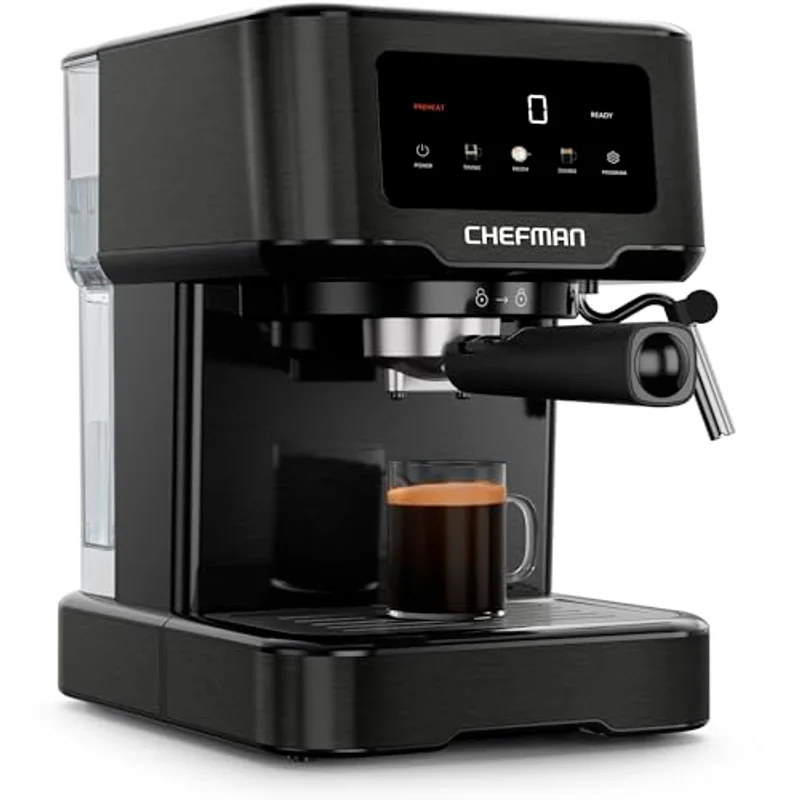
Chefman CraftBrew
15-bar pump, 1.5 L removable reservoir, programmable shot volume, two baskets. Add a hand grinder and the whole setup repays in about a month — the cheapest honest way to test the habit.
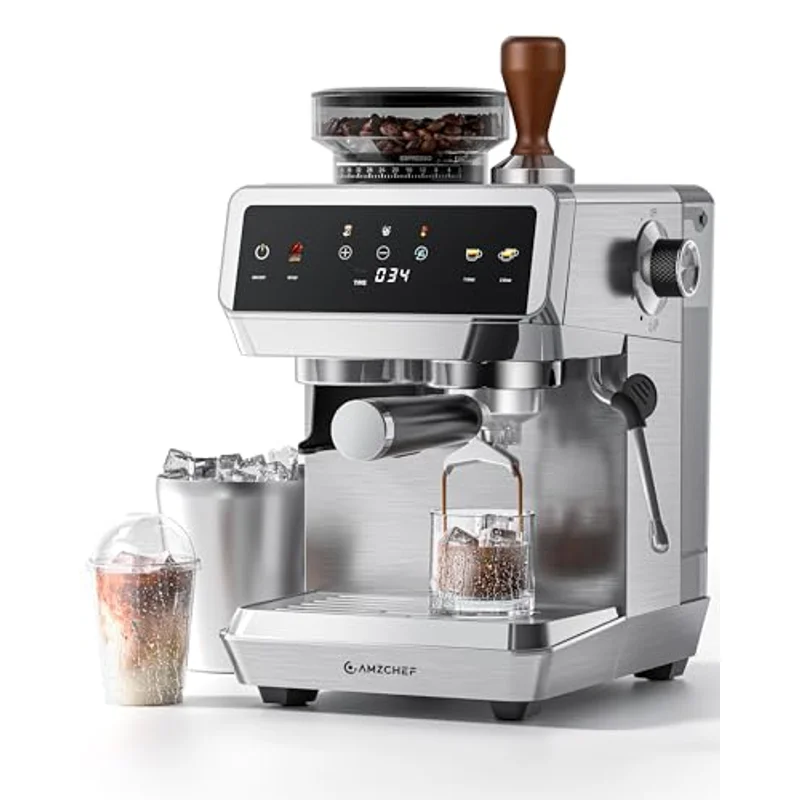
AMZCHEF with Grinder
Built-in grinder with 44 settings, brew temperature adjustable from 190 to 201 °F, 60 oz tank, descaling function. One purchase, no grinder to add, payback around six weeks.
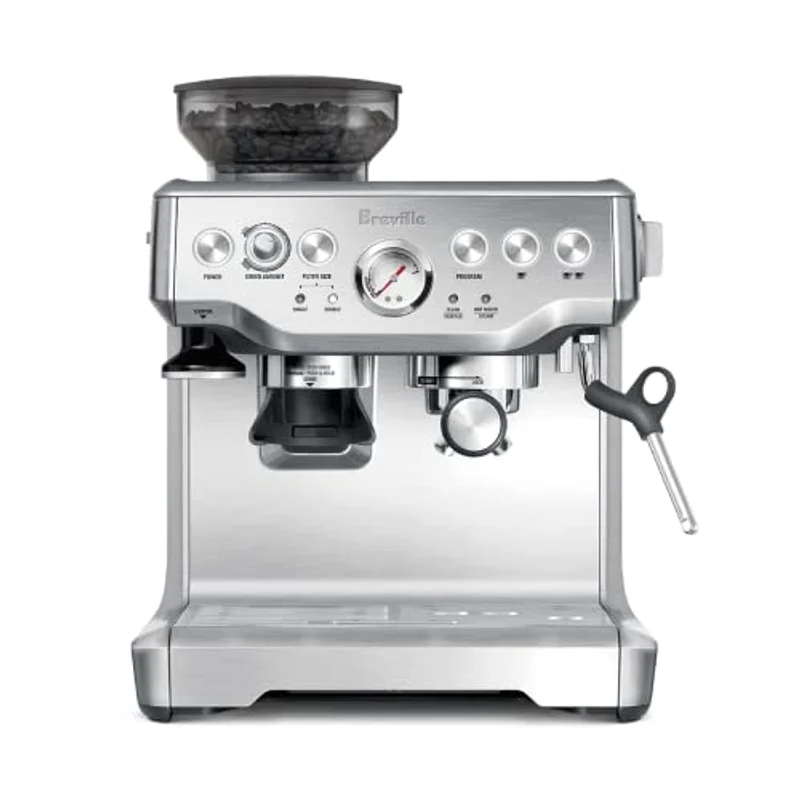
Breville Barista Express
Conical burr grinder with dose control, 54 mm portafilter, razor trimming tool, 67 oz tank, low-pressure pre-infusion. Five months to repay, and a ceiling you won't outgrow.
If the ritual is the part you don't want, buy one-touch: the De'Longhi Magnifica Start grinds, doses and brews behind a single button, three recipes, 13 grind settings, repaying in about 4.6 months on the same assumptions. If convenience is non-negotiable and you accept the per-cup cost with open eyes, the Ninja CFN601 is defensible — just don't call it the cheap option. For the full field, the main espresso machine guide ranks eight machines by buying situation.
Questions we get asked
How long does a home espresso machine take to pay for itself?
On the assumptions used here — a $6 café latte, a $1.35 home latte, one drink a day, 30.4 days a month — an $80 machine plus a $60 hand grinder repays in about one month, a $200 machine with a built-in grinder in about 1.4 months, and a $685 machine in about 4.9 months. Two drinks a day halves all of those. Replace $6 and $1.35 with your own numbers first.
How much does a homemade latte actually cost?
About $1.35 on illustrative US 2026 figures: $0.85–1.05 of coffee for an 18 g double from a $16–20 bag of 340 g beans yielding roughly 19 doubles, plus $0.30 of milk at $4.80 a gallon, $0.02 of electricity, and $0.08 a day of descaler and filters. Without milk, closer to $1.05.
Is a capsule machine cheaper in the long run?
Usually not, if you drink double-strength coffee. A capsule holds about 5 g at roughly $0.90 — about $0.18 per gram against $0.047–0.059 for beans. At two capsules per drink the $279.95 Ninja CFN601 costs about $4,167 over five years at one drink a day, while the $694.94 Barista Express costs about $3,149; the cheaper machine overtakes it at roughly 519 drinks, about 17 months. Drink single capsules and the picture is far closer.
Who should not buy a home espresso machine?
Occasional drinkers whose habit is two or three milk drinks a week, since payback stretches and the machine goes unused; people whose real preference is mugs of drip coffee; people with no permanent counter space; and anyone who won't descale on schedule, since limescale is the main killer of home machines. A hand grinder with a moka pot or AeroPress is a better use of the money.