The Best Espresso Machines With a Milk Frother (2026)
Steam wand or automatic frother? The machines that actually make a decent flat white at home, from $80 to $600 — and the honest gap between what a cheap wand can do and what a real one can.
Reader-supported: we may earn a commission if you buy through our links, at no extra cost to you. Prices are the ones we recorded on August 13, 2026 and they move constantly on Amazon — confirm the live price before buying.
The short answer
If you want a real flat white or latte art and don't mind learning a skill, buy a machine with a manual steam wand — the CASABREWS 3700 Essential at $99.99 for a stainless first machine, or the CASABREWS CM5418 at $139.99 if you want a pressure gauge to see what you're doing. If you want a decent cappuccino with zero technique, buy a machine that automates the wand instead: the Maestri House Slim at $139.99 or the atatix at $111.08 both build the frother into a one-touch routine, and the Breville BES450BSS Bambino at $299.95 automates a real steam wand rather than a foaming attachment, which is the meaningful difference at that price. At the top, the Ninja Luxe Café Premier 3-in-1 at $599.00 pairs a built-in grinder with a dual automatic froth system that handles both hot microfoam and cold foam.
The category mistake is assuming "has a milk frother" means one thing. It doesn't. Some listings mean a panarello attachment that whips air into milk and calls it froth; some mean an automatic wand that heats and textures milk to a set point with no input from you; some mean a genuine manual wand you steer yourself. All six machines below are real, and we say exactly which kind of frothing each one ships with, because that's the spec that decides whether your Sunday cappuccino looks like a café's or like a science-fair volcano.
Steam wand vs automatic frother: what each actually does to milk
Both routes start the same way: steam from the boiler is forced through a nozzle into cold milk, and the heat plus the turbulence pull air into the liquid while breaking the fat and protein into a stable foam. Where they diverge is who controls the two variables that decide the result — how much air goes in, and how hot the milk gets before you stop.
A manual steam wand puts both in your hand. You choose the depth of the tip in the jug, the angle, and the moment you pull it out, which is also the moment you decide the milk is done — usually judged by the jug's temperature against your palm, since dairy scalds and turns sulphurous well before it boils. That control is exactly what produces microfoam: fine, glossy, integrated bubbles you can pour into a rosette rather than a layer of macrofoam sitting on top like meringue. It's also exactly what a first-time user gets wrong, which is why the first week with a manual wand usually produces more foam than flat white.
An automatic frother removes both variables. Some machines pump a fixed amount of air and steam through a milk jug via a wand-shaped nozzle and shut off on a timer or a built-in thermostat; some use a separate frothing chamber the jug sits in. Either way, you press one control and walk away with a repeatable result — repeatable being the operative word, since it does the same thing every morning, for better and for worse. It cannot adjust for a jug that's half full versus nearly empty, or for whole milk versus oat, the way a person steaming by hand can.
Neither route is the "correct" one; they're a trade of ceiling for consistency. A trained manual wand beats every automatic frother on this page for texture — that's not a product claim, it's how the two mechanisms work. But an automatic frother beats a manual wand on the days you're not going to practice, which for most households is most days. Machine class matters here too: our guide to semi-automatic vs super-automatic machines covers how milk handling changes across those categories more broadly.
Why cheap panarello wands foam but don't texture (and when that's fine)
A panarello wand is a steam tip with a second, outer sleeve around it that has small holes cut into the side. As steam exits the inner tip, it draws room air in through those holes before it ever touches the milk — a venturi effect, the same principle that lets a perfume atomizer pull liquid up a tube. The milk gets a rush of pre-mixed steam and air at once, rather than steam alone that you fold air into yourself by adjusting depth and angle.
That's fast and forgiving, which is exactly why budget machines ship with one: point it in, and foam happens without any technique. It's also why the foam is coarse. The air is added mechanically and in bulk rather than incorporated gradually, so bubbles are large and uneven rather than fine and glossy — closer to a cappuccino topping you spoon on than microfoam you pour into a pattern. A panarello sleeve can usually be removed to expose a plainer steam tip underneath, which narrows the airflow and moves the result closer to what a proper wand produces, but the smaller, single-hole tips on machines like the Bambino are built for microfoam from the start rather than adapted toward it.
When is coarse foam fine? For a cappuccino, honestly, often. A traditional cappuccino wants a thicker foam cap rather than the silky integration a flat white or latte needs, so a panarello wand's natural output lands closer to correct there than it does for anything you'd pour into art. The failure mode is expecting the same wand to also produce a flat white — that's the gap between "foams" and "textures," and no amount of practice on a panarello sleeve closes it the way a plain tip does.
The picks, from $90 to $600
Ordered by price. We name six machines because the category splits cleanly into automatic and manual routes at three price points, and each one suits a different answer to "how much do I want to think about milk."
Under $100: an automatic frother, or a real steam wand you learn
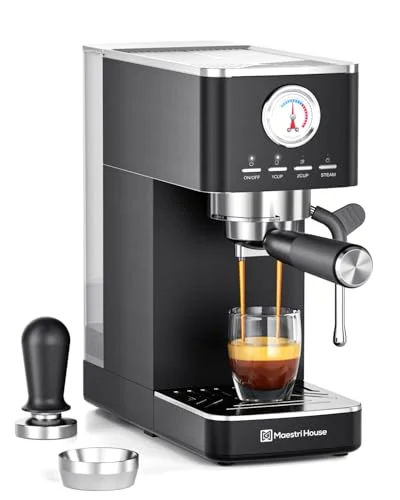
Maestri House Slim Espresso Machine with Milk Frother
A 20-bar Italian pump machine built around the 1.3 L Espresso Machine size and a milk frother as part of the package rather than an add-on — the automatic route at the lowest price on this page. Best for someone who wants a milk drink without learning a wand at all.
$66.49 Check price →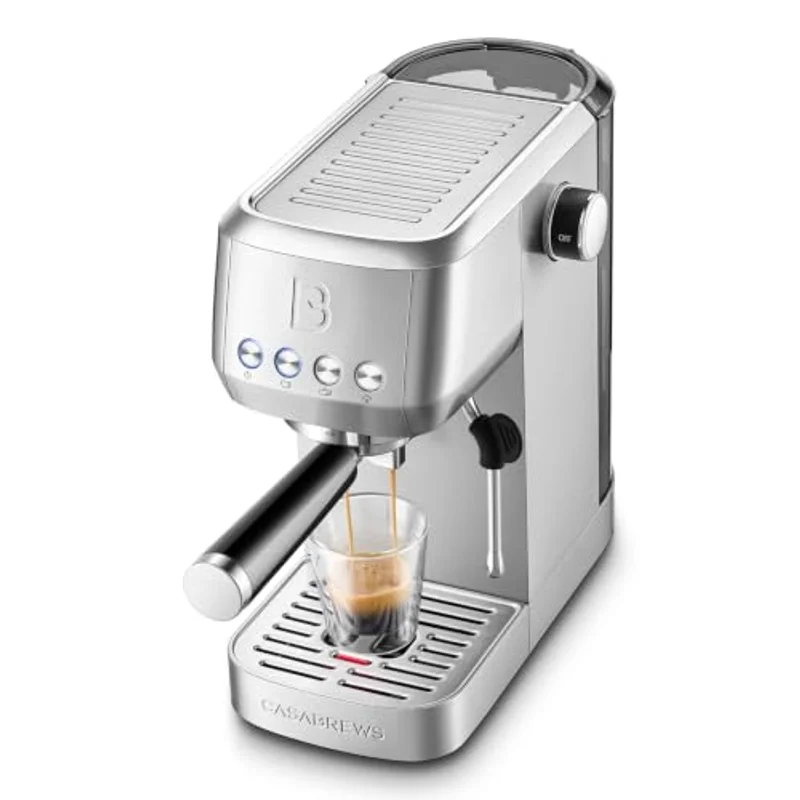
CASABREWS 3700 Essential Stainless Steel Espresso Machine with Steam Wand
The manual route at the same price bracket: a real steam wand rather than an automatic attachment, in a stainless 12.6 × 5.7 × 12.2 in footprint narrow enough for a small kitchen. Best for someone who wants to learn the skill, not skip it.
$99.99 Check price →$120–$140: a little more machine, same two routes
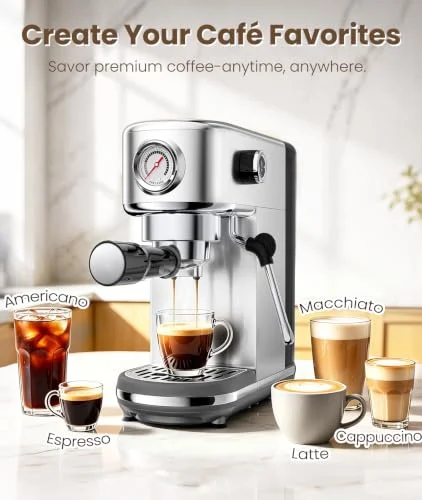
atatix Espresso Machine with Milk Frother, 20 Bar Pressure
Another 20-bar pump machine with the frother built into the appliance rather than sold separately, in a compact size. Best for someone already sold on the automatic route who wants a step up from the very cheapest listing.
$111.08 Check price →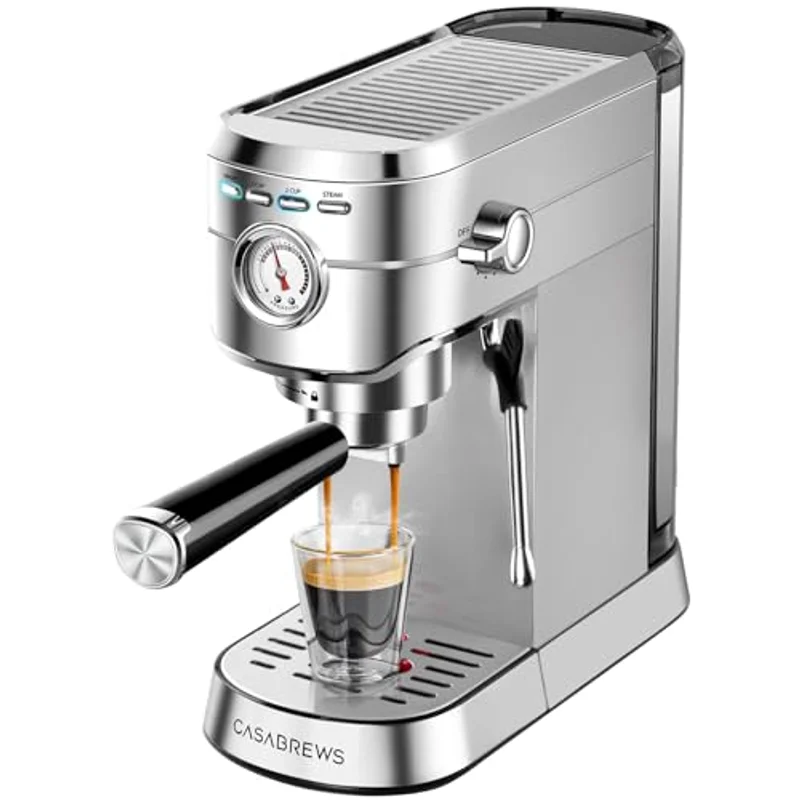
CASABREWS CM5418 Compact Espresso Machine with Milk Frothing Steam Wand
A small-footprint machine built around a steam wand rather than an automatic attachment — the manual route, one tier up from the CASABREWS 3700. Best for someone who wants a wand plus a bit more machine around it, without moving into three-figure-plus territory.
$139.99 Check price →$300: the automatic-wand splurge
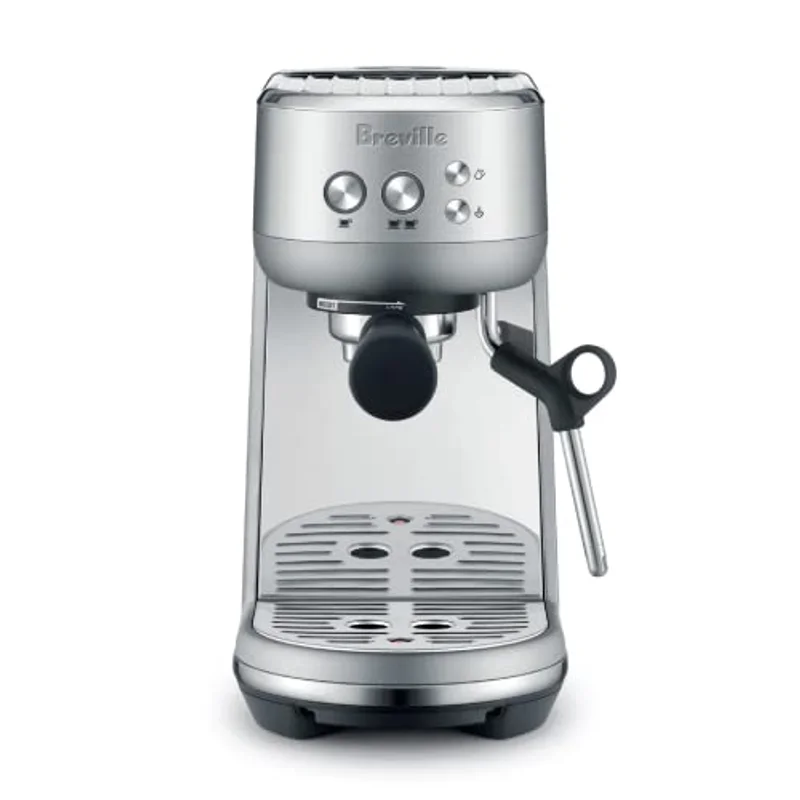
Breville BES450BSS Bambino Espresso Machine
The meaningful jump at $299.95 isn't more power, it's what's being automated: an automatic microfoam steam wand rather than a foaming attachment, in a small stainless footprint with no built-in grinder. Best for someone who wants café-texture milk without steering a wand by hand, and who already has (or will buy) a separate burr grinder — see our grinder comparison for that trade.
$299.95 Check price →$600: milk, coffee and grinder in one machine
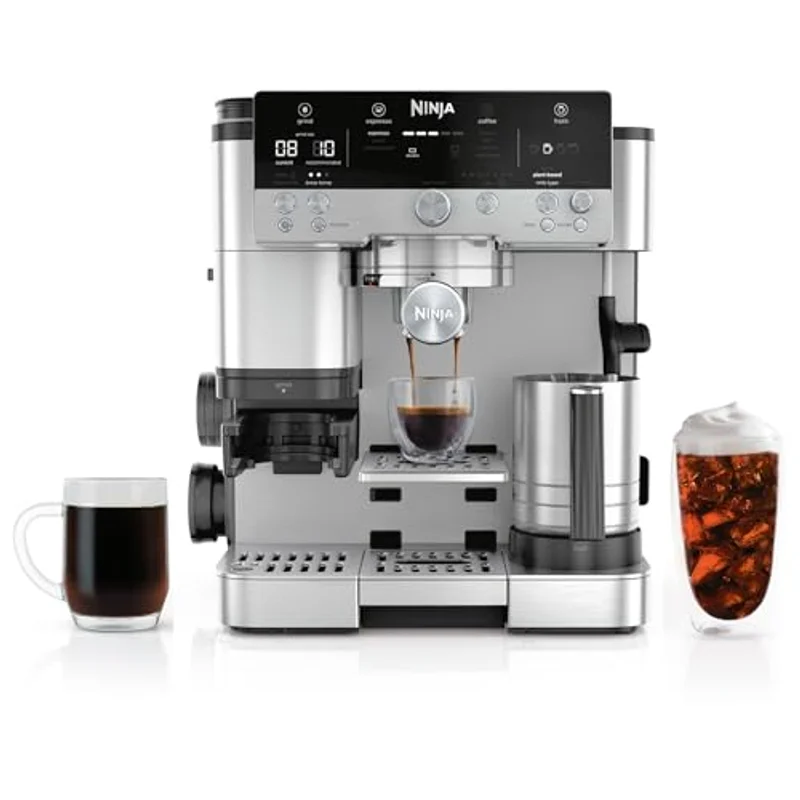
Ninja Luxe Café Premier 3-in-1 Espresso Machine
At $599.00 and roughly 13 × 13.4 × 14.6 in, this is the widest brief on the page: espresso, drip coffee and cold brew from one built-in grinder, plus a dual automatic froth system that covers hot microfoam and cold foam rather than one or the other. Best for a household that wants milk drinks, filter coffee and cold brew out of a single appliance and has the counter space for it.
$599.00 Check price →Milk choice, jug size and temperature: the three things owners get wrong
The machine gets most of the attention in reviews; these three variables quietly decide more of the result than the wand itself.
Milk choice. Foam stability comes from protein and fat working together — protein forms the bubble walls, fat coats and stabilizes them. Whole dairy milk has both in the proportions that steam most predictably, which is why it's the standard by which frothing performance gets judged. Skim milk foams tall because there's less fat to weigh the bubbles down, but that foam is drier and collapses faster. Plant milks vary enormously by brand and by what's added to help them foam — oat milks marketed as "barista" blends behave far more like dairy than a plain oat milk does, and the difference between two oat cartons on a shelf can be larger than the difference between two machines. If a drink isn't texturing the way you expect, changing the milk is often a faster fix than blaming the wand.
Jug size. Milk roughly doubles in volume as it's steamed into foam, so the jug needs enough headroom for that expansion or it overflows before it's textured. The opposite problem is more common with small jugs: too little milk in too much jug means the wand tip can't stay submerged at a workable depth, so you get spitting and uneven heat instead of a smooth vortex. Matching jug size to the amount of milk you actually drink — a single flat white's worth versus milk for three cappuccinos — matters more than jug material or shape.
Temperature. Dairy proteins start breaking down and milk starts tasting cooked, sometimes faintly sulphurous, once it gets meaningfully into the 150s°F, well before boiling. Automatic frothers with a thermostat cut off at a preset point for exactly this reason. On a manual wand the usual method is judging jug temperature against the outside of your hand — comfortable to hold briefly, then noticeably hot is the general signal to stop, though the machine's own guidance should be your reference for a specific unit. Overheated milk doesn't just taste worse; it foams worse too, since the same protein damage that changes the flavor also destabilizes the bubble structure.
What you give up under $150, honestly
Every machine on this page under $150 is a real pump espresso machine with real milk frothing, not a downgrade to a steam-driven toy. What you give up is more specific than "quality," and worth naming directly.
Fine control. Panarello-style automatic frothers and simpler wands give you a result, not a range of results. A Bambino-class automatic wand or a manual wand you've practiced on can hit a spectrum from thick cappuccino foam to silky microfoam depending on technique; a budget frother mostly gives you one output, well-suited to some drinks and wrong for others.
Built-in grinders. None of the six machines here include one — milk hardware and a grinder rarely show up together under $150, since both cost real money to do well. Espresso is unforgiving about grind size, so pair any of these with a proper burr grinder rather than pre-ground coffee; our guide to pulling a good shot covers why that matters and how to dial one in. If a built-in grinder is the priority instead of milk hardware, our picks under $200 covers that trade-off directly.
Thermal recovery. Small boilers on budget machines take longer to reheat between a shot and steaming milk, or between two milk drinks back to back. One cappuccino is fine; three in a row for guests means waiting between each. This is a boiler-size limitation shared by every compact machine in this bracket, not a defect specific to any one of them.
Marketing pressure numbers. Several machines here advertise 20-bar pumps. Espresso brews at roughly 9 bar at the coffee itself; the 20-bar figure describes the pump's maximum, not what reaches the puck. It's not a false claim, but it's not a differentiator either — treat it as background noise and judge these machines on their milk system and boiler instead.
Verdict by drink: cappuccino at home vs latte art ambitions
The honest recommendation depends on which drink you actually want most mornings, more than on budget alone.
Mostly cappuccino. A cappuccino wants a thick, stable foam cap rather than integrated microfoam, which is exactly what an automatic frother or an unmodified panarello wand produces naturally. The Maestri House Slim at $139.99 or the atatix at $111.08 are built for this and don't ask you to learn a technique to get there. You're not compromising by choosing the automatic route for cappuccino — the mechanism and the drink are well matched.
Latte art ambitions. Rosettes and hearts need thin, glossy microfoam poured with control, and that's a manual-wand skill that no automatic frother replicates, because the pour technique is inseparable from how the milk was textured in the first place. The CASABREWS 3700 at $99.99 or the CM5418 at $139.99 give you a real wand to practice on for the price of learning; the Bambino at $299.95 automates a proper wand's steam quality but still expects you to pour, since art happens at the pour, not at the steam. Expect the first several weeks with any manual wand to look more like foam than art — that's the same learning curve as pulling a consistent shot, which is worth reading about in our shot-pulling guide if you're starting from zero on both fronts at once.
Both, and a household to match. The Ninja Luxe Café Premier at $599.00 is the only machine here that pairs milk hardware capable of hot and cold foam with a built-in grinder and two other brew styles, which is the case for it if espresso is one of several things your kitchen needs to produce rather than the only thing.
The six, side by side
Sorted by price. Prices move constantly on Amazon — confirm the live price before you buy.
| Machine | Milk system | Size | Price | |
|---|---|---|---|---|
| Maestri House Slim | Built-in milk frother | 1.3 L Espresso Machine | $66.49 | Price |
| CASABREWS 3700 Essential | Manual steam wand | 12.6 × 5.7 × 12.2 in | $99.99 | Price |
| atatix, 20 Bar Pressure | Built-in milk frother | Compact | $111.08 | Price |
| CASABREWS CM5418 | Milk frothing steam wand | Small | $139.99 | Price |
| Breville BES450BSS Bambino | Automatic microfoam wand | Small | $299.95 | Price |
| Ninja Luxe Café Premier 3-in-1 | Dual automatic froth system | 12.99 × 13.39 × 14.57 in | $599.00 | Price |
How we compared these
We compare published specifications, product names and descriptions, machine class, footprint and live pricing — we do not physically test these machines, we do not run a testing lab, and we do not publish ratings we cannot verify. Amazon's product data returns no rating and no review count for the machines on this site, so there are no stars and no invented scores anywhere on this page, and we do not paraphrase review sentiment we have no data for.
Where a spec isn't stated for a product — a jug size, a wattage, an exact wand type beyond what the listing name tells us — we say so rather than guess, and we point you to the live listing instead. The general milk-science and pressure facts in this guide (protein and fat driving foam stability, espresso brewing at roughly 9 bar at the puck, dairy breaking down well before boiling) are standard background rather than claims about any one product. Where a recommendation is a judgement call — which drink suits which route, what the $150 line gives up — we've said so in our own voice so you can weigh it yourself. The broader cost question sits in are home espresso machines worth it, and cleaning milk residue out of a wand is covered in our cleaning and descaling guide.
Frequently asked questions
Is a steam wand better than an automatic frother?
For texture, yes — a trained manual wand can produce finer, glossier microfoam than an automatic frother, because a person can adjust depth, angle and stop point to the milk in front of them. For consistency with no learning curve, the automatic route wins, since it does the same thing every time you press it. Neither is universally "better"; it's a trade of ceiling against convenience.
Why does my panarello wand only foam the milk instead of texturing it?
A panarello sleeve pulls room air into the steam through small holes before it reaches the milk, adding air in bulk rather than the gradual, controlled way a plain steam tip does. That produces coarse, stable foam quickly — good for a cappuccino cap — but not the fine, integrated microfoam a flat white or latte art needs. Removing the outer sleeve, where the machine allows it, moves the result closer to a plain wand's output.
What's the biggest thing you give up on a milk-frother machine under $150?
Fine control over the result, more than raw quality. Budget automatic frothers and simple wands mostly produce one type of foam well rather than a range you can dial between thick cappuccino foam and silky microfoam. None of the machines in this bracket include a grinder either, so pair one with a separate burr grinder rather than pre-ground coffee.
Which pick suits cappuccino, and which suits latte art?
For cappuccino, an automatic frother or an unmodified panarello wand is a good match, since both naturally produce the thicker foam cap the drink wants — the Maestri House Slim or the atatix cover that route cheaply. For latte art, you need a manual wand to practice on, like the CASABREWS 3700 or CM5418, or an automated version of a real wand like the Bambino, since pour technique depends on how the milk was textured in the first place.